Pilot training programs · KVNC Venice FL
Build a career.Or fly for love.
Venice is a good place to learn. The airspace over KVNC stays quiet, the Gulf Coast gives you flyable weather most of the year, and you'll log real stick-and-rudder time instead of waiting in line to take off. The ladder below runs from your first hour of instruction to the right seat of an airliner. Pick a path to highlight it, or leave it on Both and see everything. We train under FAA Part 61, so your path is built around you and your schedule rather than a fixed course calendar.
0
Steps on the ladder
$0
Discovery flight
0
Driver's license to start Sport
0
Hrs to Commercial
Rung 02 · Sport Pilot
Sport Pilot.The easiest way into the air.
Fewer hours than a Private certificate, lower cost, and a medical requirement most people already meet: a valid US driver's license. If you've wanted to fly and kept putting it off, Sport is usually the quickest way to start.
- Min flight hours
- 20 hours
- Medical
- US driver's license
- Ground school
- Included
- Aircraft
- Light sport eligible
- Flies with
- One passenger
- End state
- FAA Sport Pilot
No FAA medical needed to begin
For a Sport Pilot certificate you can use a valid US driver's license in lieu of an FAA medical certificate to show you're fit to fly. That's a real FAA rule, and it removes the biggest hurdle for a lot of older pilots and people coming back to flying after years away. You still self-certify that you feel well on the day you fly, same as any pilot does.
What you can do with it
Fly a light sport aircraft in daytime visual conditions, carry one passenger, and see the Gulf Coast from the air. Many Sport Pilots later add privileges and move up to a Private certificate, so you can start here and keep going if you want to.
Where to read more
FAA Sport Pilot reference: faa.gov/pilots/become. The medical eligibility rule lives in 14 CFR 61.23.
Rung 03 · Ground School
Ground School.The classroom behind the cockpit.
Flying is half stick-and-rudder and half knowing why the airplane does what it does. Ground school is where you learn the second half. We run classes you can sign up for, on the ground and in the aircraft, so the book learning and the flying line up.
- Format
- Classroom + in-aircraft
- Sign up
- By class
- Preps you for
- FAA written exams
- Pairs with
- Every rating
- Pace
- Group or one-on-one
- End state
- Ready for the written
What we cover
Weather, regulations, aerodynamics, navigation, airspace, aircraft systems, and the decision-making that keeps you safe. We teach it on the ground in plain language, then point to the same ideas in the airplane so they stick. No memorizing for a test you forget the week after.
Sign up for classes
Ground school is growing, and you can sign up for classes as they open. Whether you're chasing a Sport, Private, or Instrument written, the classroom work runs alongside your flying instead of stacking up at the end. Ask us about the current schedule when you come out for your discovery flight.
Rung 04 · Private Pilot
PPL.The full license.
The foundation. Once earned you can fly a single-engine airplane in visual conditions with passengers, day or night, anywhere in the country. Most students take six to nine months from first lesson to checkride if they fly twice a week.
- Min flight hours
- 40 hours
- Realistic range
- 55 to 75 hours
- Ground school
- Included
- Aircraft
- Well-maintained trainers
- Prerequisite
- 3rd Class medical
- End state
- FAA PPL
What you learn
Aircraft control, takeoffs and landings, navigation by visual and pilotage reference, basic instrument flight, cross-country flight planning, night flight, towered and non-towered communications, weather decision-making, the federal aviation regulations, and the practical test standards for the Private Pilot checkride.
What is included
Dual instruction with the same CFI from your first lesson through your checkride, ground school (one-on-one or small group), pre- and post-flight briefings, three solo cross-countries, all required night flight, and full checkride prep including a mock practical. We sign your endorsements when you're ready, not when the calendar says so. The airplanes you fly are kept by our own A&P shop, so a squawk gets caught by the same team that teaches you.
Where to read more
FAA pilot certification reference: faa.gov/pilots/become. Community resources at AOPA learn-to-fly.
Rung 05 · Instrument Rating
Instrument.Fly through weather you used to wait out.
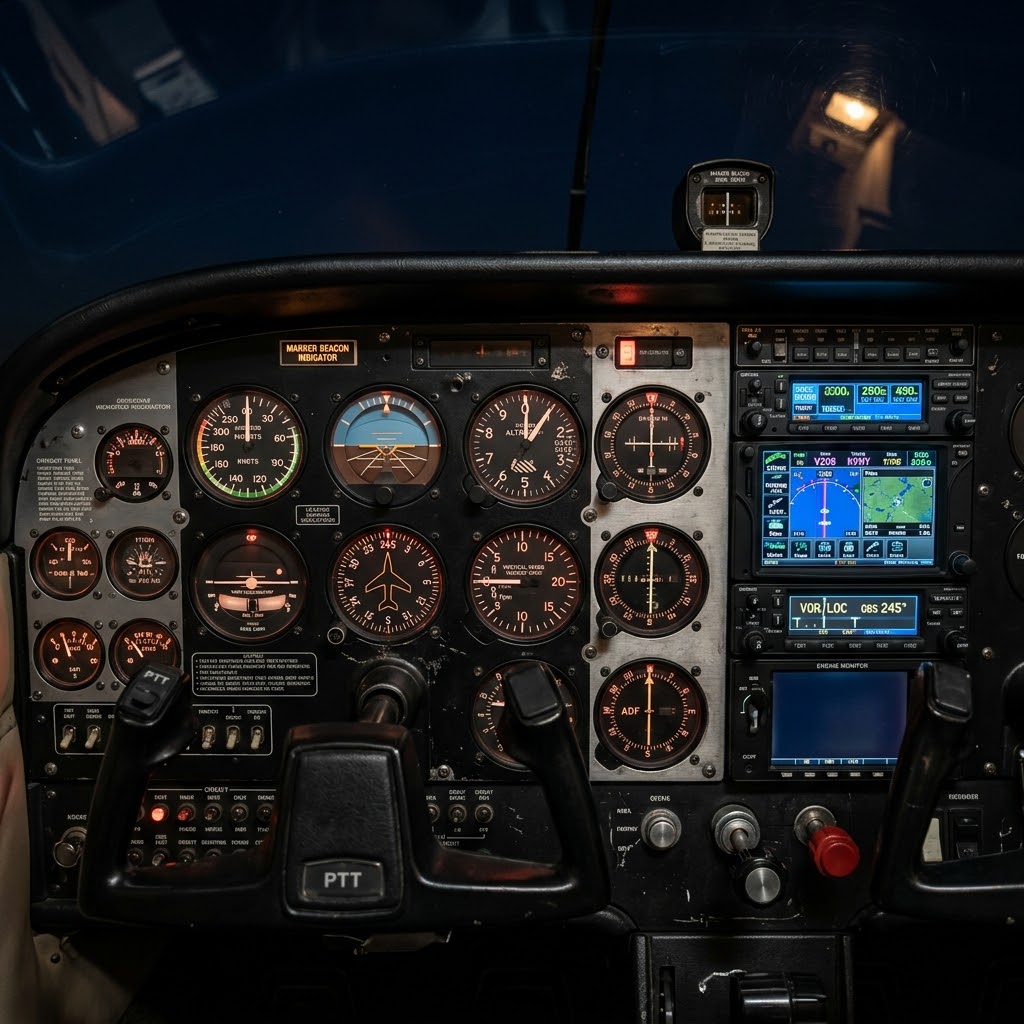
The certificate that makes you a real cross-country pilot. Florida's afternoon thunderstorms and frequent IMC give you actual instrument conditions to train in instead of waiting for clear skies.
- Instrument time
- 40 hours min
- Cross country
- 50 hours PIC X-C
- Prerequisite
- Private Pilot
- Aircraft
- IFR-equipped trainer
- Ground
- Procedures + briefings
- End state
- FAA Instrument Rating
What you learn
Instrument scan, partial-panel flight, holds, intercepts, IFR navigation by VOR and GPS, ILS and LPV precision approaches, non-precision approaches, departure and arrival procedures, ATC communication under IFR, weather analysis at a working-pilot level, and decision-making for actual instrument conditions.
Why Florida is the place
The Gulf Coast gives you actual instrument conditions to train in: summer buildups, winter fronts, and the coastal marine layer. You finish with real IMC in your logbook, not just hood time.
Rung 06 · Commercial
Commercial.The certificate that lets you get paid.
The step from flying as a hobby to flying for a living. Precision maneuvers, a complex-aircraft endorsement, and the polish that separates a private pilot from a paid one.
- Total time
- 250 hours min
- PIC required
- 100 hours
- Cross country
- 50 hours PIC X-C
- Prerequisite
- Private Pilot
- Aircraft
- Complex / TAA
- End state
- FAA Commercial
Commercial maneuvers
Chandelles, lazy eights, eights on pylons, steep spirals, power-off 180 accuracy landings. Complex aircraft systems. Operational decision-making at a professional standard. Every maneuver is flown to tight FAA precision tolerances.
What is next
Add an Instrument Rating if you don't already have one. Many graduates go from Commercial into the CFI track to build hours toward an airline interview. Some go straight into the part 135 charter world.
Rung 07 · CFI
CFI.Teach what you have learned.
This is where you learn to teach flying. You fly every maneuver from the right seat, explain it as you go, and prove you can pass it on to a student.
- Prerequisite
- Commercial + Instrument
- Knowledge tests
- FOI & FIA
- Spin endorsement
- Required
- Right-seat time
- 15 to 25 hrs typical
- Aircraft
- Well-maintained trainers
- End state
- FAA CFI
What you learn
Fundamentals of Instruction: how adults learn, lesson plan construction, the role of the instructor, evaluation and critique. Then commercial maneuvers from the right seat with running narration. Then spin training and spin endorsement.
Stay and instruct
Graduates of our CFI program are first in line to join our instructor staff. Build hours toward an airline interview while teaching at the school that trained you.
Rung 08 · CFII
CFII.Teach the instrument approach.
Add the instrument privilege to your CFI, and you can teach the Instrument Rating, a specialty in steady demand on the Florida Gulf Coast.
- Prerequisite
- CFI + Instrument
- Knowledge test
- FII written
- Right-seat IFR
- Required
- Aircraft
- IFR-equipped trainer
- End state
- FAA CFII
Instrument from the right seat
Verbal narration, approach setup teaching technique, partial-panel teaching, weather decision-making coaching for student instrument pilots, IFR system failures and the right way to demonstrate them.
Why CFIIs stay in demand
CFII demand on the Florida Gulf Coast is consistent. Most Private Pilots want their Instrument Rating because they want their airplane to be useful in weather, and that demand needs CFIIs. Adding this rating opens up more billable instructor hours.
Tools · Stack your path
Pick the ratings you want.See what it takes.
Tick the boxes for the certificates on your roadmap. The panel shows the FAA legal minimum flight hours to reach your highest selection, a realistic calendar estimate at twice-a-week training, and your end-state certificate.
When you are ready to talk specifics, the discovery flight is the start.
Min flight hrs
0
Est. months
0
End state
-
These are FAA Part 61 legal minimums to reach your highest selection. Almost everyone needs more than the minimum. Your real hours depend mostly on how often you fly: twice a week finishes faster and costs less than once a month, because you spend less time relearning the last lesson. It's a starting point, and we'll quote you a real number once we talk.
Questions most students ask.
How long does PPL take?
FAA minimum is 40 flight hours. Realistic Florida students average 55 to 75 hours from first lesson to checkride. Twice-a-week flyers finish faster than once-a-month flyers. Six to nine months is a normal range.
Do I need an FAA medical to start?
For Sport Pilot training you can use a valid US driver's license in lieu of an FAA medical certificate to show medical eligibility. It's a real FAA rule and a big reason Sport is the easiest way in. For Private Pilot and up, you'll need a Third Class FAA medical from an Aviation Medical Examiner before you solo.
Do I need to buy an airplane?
No. We rent ours to students. Plenty of graduates do buy eventually, often through us, but it isn't required for any rating.
Can I sign up for ground school?
Yes. Ground school is growing, and you can sign up for classes as they open. We teach it in the classroom and in the aircraft so the book learning and the flying line up. Ask us about the current schedule.
Can I use my GI Bill or VA benefits?
We're working on VA benefit eligibility. If you're a current student with a specific situation, call us and we'll walk through it.
Do you offer flight reviews and IPCs for outside pilots?
Yes. Flight reviews under 14 CFR 61.56, instrument proficiency checks, and BFRs are available year-round.